Before any of this: the American Academy of Dermatology is clear that effective treatment for hair loss starts with finding the cause, and that getting an accurate diagnosis means seeing a board-certified dermatologist (AAD, hair loss diagnosis and treatment). Thyroid disease, low iron, hormonal change and medication all cause shedding, and no cosmetic product on this page addresses any of them.
The growth cycle, in the thirty seconds it takes
Every follicle on your head runs its own independent cycle with three phases: a long growth phase lasting years, a short transition phase, and a resting phase at the end of which the hair is released and a new one begins growing from the same follicle.
Because the cycles are not synchronized, a steady trickle of hairs reaches the end of theirs every day. That trickle is shedding, and it is the system working. The AAD puts the normal range at roughly 50 to 100 hairs a day, and notes that people with longer or denser hair notice more of it simply because each hair is more visible (AAD, hair loss overview and causes).
Everything on this page follows from one distinction: whether the follicle replaces the hair it released. If it does, you are shedding. If it does not, or if it replaces it with something thinner and shorter each cycle, you are losing hair. Those are different problems with different answers, and telling them apart is worth more than any product.
What shedding is, and when more of it is still shedding
A shed hair comes out at the root. If you look closely at one from your brush you will often see a small pale bulb at one end — that is the end that was in the follicle, and its presence means the hair completed its cycle rather than breaking.
Shedding also comes in waves, which is the part that frightens people unnecessarily.
- Seasonal shedding is well described and peaks in late summer and autumn. It is temporary and it resolves on its own.
- Shedding after a wash is a counting artifact. Hairs that were already released stay tangled in the rest until water and conditioner free them, so a three-day gap between washes produces three days of hair in one shower.
- Telogen effluvium is a heavy, diffuse shed two to three months after a trigger — illness, surgery, a crash diet, childbirth, a stressful period, a new medication. The lag is the signature, and the AAD describes it as typically temporary with regrowth once the trigger resolves (AAD, types of hair loss). This is the single most common reason someone decides their hair is falling out.
The reassuring thing about all three: the hairline holds, the part does not widen, and the density recovers. More hair on the floor is not the same as less hair on your head.
What hair loss is, and what it looks like
Hair loss shows up in the mirror rather than in the drain, and that is the most useful single sentence here. The signs are about distribution and coverage, not volume on the floor.
- A widening part. The classic early sign of female pattern hair loss — the AAD describes a part that broadens over time with thinning concentrated on the top of the head (AAD, female pattern hair loss).
- A receding or thinning temple line, or a thinning crown, which is the typical male pattern.
- A ponytail that is thinner at the base, not just at the tip. Thinner at the tip is breakage; thinner all the way through is density.
- Visible scalp in ordinary light where there was none a year ago.
- Shorter, finer, wispier hairs replacing normal ones in the affected area. This is miniaturization, and it is the mechanism behind pattern loss — the follicle is still working but producing progressively less each cycle.
- Distinct round patches, which is a different condition again and needs a doctor rather than a shelf.
Notice that none of these is a hair count. Pattern hair loss can progress for a year without any change in how much hair you find in the shower, because the follicles are miniaturizing rather than quitting.
From the picks
What to reach for, once you know which it is
A leave-in aimed at mid-length breakage, a thinning-hair shampoo if the scalp is the thing you want to change, and the cheapest credible peptide scalp serum if you want to try the topical category. All three are cosmetic, and none of them is a substitute for a diagnosis.
Best leave-in for fragile hair
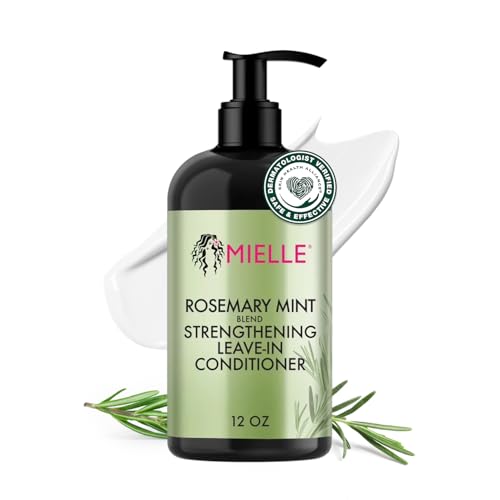
Mielle Organics Rosemary Mint Strengthening Leave-In Conditioner
The leave-in companion to the rosemary oil, and the more useful of the two for most people: length is usually lost to breakage rather than to slow growth, and a leave-in reduces breakage.
Best thinning-hair shampoo
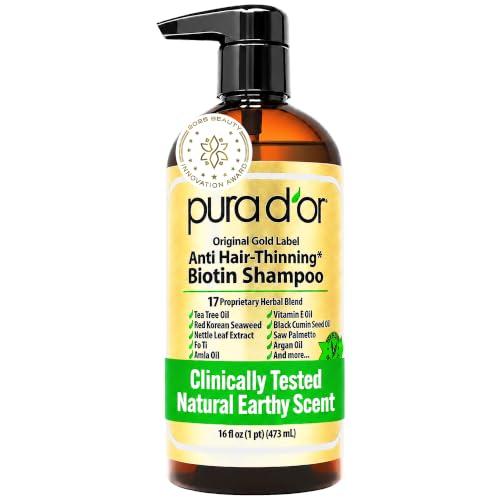
Pura d'or Original Gold Label Anti-Thinning Biotin Shampoo
A sulfate-free shampoo built around biotin and botanicals, positioned for the appearance of thinning caused by breakage. That framing is narrower than the category usually claims, and more defensible for it.
Best value peptide serum
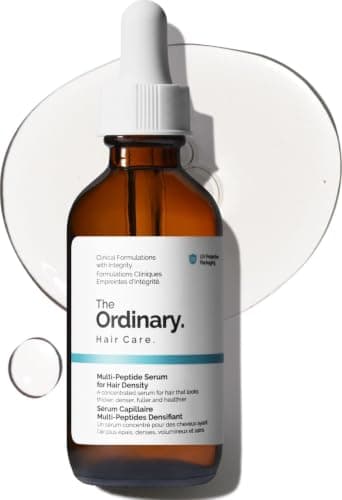
The Ordinary Multi-Peptide Serum for Hair Density
A leave-in peptide serum at a fraction of the usual price. The Ordinary describes it as improving the appearance of thickness and fullness — an appearance claim, which is the honest framing for this whole category.
Breakage, which is neither and looks like both
The third category, and the one most often misdiagnosed, because the result — less hair, thinner-looking length — is identical from a distance.
A broken hair snaps along its length rather than releasing at the root. The tell is the end: no pale bulb, and usually a fairly even, blunt break. Other signatures:
- Short pieces standing up along the part and around the hairline, all roughly the same length.
- Length that has stopped increasing even though your hair is clearly growing at the root.
- A ponytail thinner at the tip than at the base.
- Hair that snaps when you pull a wet strand instead of stretching — which points at protein overload or structural damage, covered here.
Breakage is the best news of the three, because the causes are all things you control: heat, bleach, tight styles, brushing wet hair, and the mechanical friction of elastics and pillowcases. Change the handling and it stops within weeks. Best products for split ends and do you need a heat protectant are the practical pages, and a light conditioner is the single most useful product.
Two tests that tell them apart in five minutes
1. Look at the ends of the fallen hairs. Collect a few from your brush or the shower drain and look at both ends in good light. A small pale bulb at one end means the hair shed at the root. Two blunt ends with no bulb means it broke. Do this with ten hairs rather than one — a mixture is normal, and what matters is which dominates.
2. Photograph your part, in the same place, monthly. This is the only test that distinguishes shedding from loss, because the difference is coverage over time rather than anything you can see in a single moment. Same bathroom, same light, hair dry and parted the same way, once a month. Memory is unreliable about this and photographs are not.
A third, informal check: count what you actually lose on a normal day rather than a wash day — the hairs in your brush plus the hairs on your pillow plus what comes out when you run your hands through. If it is comfortably under a hundred and your part photographs the same month to month, nothing is wrong.
When the answer is a doctor rather than a product
Several of the most common causes of genuine hair loss are medical and none of them responds to a cosmetic: thyroid disease, iron deficiency, hormonal change, autoimmune conditions and a long list of medications. The AAD's position is unambiguous — effective treatment starts with finding the cause, and that means a board-certified dermatologist (AAD, hair loss diagnosis and treatment).
Go sooner rather than later if any of these apply:
- Your part is widening, or your hairline is moving.
- You have distinct patches, or hair loss on your body as well.
- There is scalp pain, burning, scaling, redness or scarring.
- A heavy shed has continued for more than six months.
- You are losing hair alongside fatigue, weight change or new periods of illness.
- You started a new medication within the last six months.
Timing matters more here than in most of hair care. Pattern hair loss is treatable in the sense that progression can be slowed, and the earlier that starts the more hair there is to keep. Spending six months on serums while a part widens is the expensive mistake.
What a product can honestly do for each
For shedding: nothing, and nothing is needed. Shedding resolves on its own. The useful response is to rule out the triggers — iron, thyroid, a recent illness or a crash diet — and then leave it alone. A gentle routine and no tight styles is the whole intervention. Why is my hair thinning goes through the trigger list.
For breakage: a great deal, and cheaply. Conditioner, a weekly mask, a heat protectant if you use irons, looser styles and a wide-tooth comb instead of a brush on wet hair. This is the category where cosmetic products genuinely change the outcome.
For hair loss: a diagnosis first. After that, minoxidil is the only over-the-counter drug approved for it and the evidence behind it is not comparable to any cosmetic serum — hair serum vs minoxidil sets that out. Cosmetic serums and thickening shampoos change appearance and may slightly change shed rate; do hair growth serums work is honest about how much. Styling to maximize apparent density — shorter, lighter, less weight at the root — does more on the day than anything in a bottle.
We have not used these products ourselves. They are chosen from what is in the formula, what those ingredients are documented to do, and whether that matches the problem this page is about — and every product below links to the manufacturer's own page so you can check the formulation claims yourself. The full method is here.